Wet Conceptualism in Cognitive Capitalism Part II
November 6th, 2026 – 11am to 7pm
Cloud Seven
Quai du Commerce 7
1000 Bruxelles
Belgium
The event is free and open to the public, but seating is limited and RSVP is required.
For more information, please visit Cloud Seven’s website.
Speakers include: Ruth Anderwald (+ Leonhard Grond), Nicolas Bourriaud, Jörg Heiser, Warren Neidich, Sarah Matia Pasqualetti, Alexandro Segade (My Barbarian), Dirk Snauwaert, Barbara Vanderlinden, and Pieter Vermeulen.
Wet Conceptualism in Cognitive Capitalism Part II builds on two initiatives that introduced and developed the concept. The first was the exhibition Wet Conceptualism at The Opening Gallery (2022–23) in New York City, featuring Coleman Collins, Constance DeJong, Jimmie Durham, Charles Gaines, Leslie Hewitt, Agnieszka Kurant, Olu Oguibe, Jimmy Raskin, Martha Rosler, Allen Ruppersberg, Chrysanne Stathacos, and Carol Szymanski. The second was the 2025 Saas-Fee Summer Institute of Art symposium in Paris, From Dry to Wet Conceptual Art in Cognitive Capitalism, which examined historical precedents, including Jane Farver’s Global Conceptualism: Points of Origin, 1950s–1980s (1999) and Romantic Conceptualism, curated by Jörg Heiser and his team at Kunsthalle Nürnberg in 2007. This second iteration extends that trajectory, shifting its geographical focus from New York and Paris to Brussels.
Emerging between approximately 1965 and 1972, conceptual art developed before Wet Conceptualism existed as a category. Works that might now fall within it were either absorbed into the canon of Dry Conceptualism or excluded altogether. Rooted in industrial capitalism and Fordist production, Dry Conceptualism responded to mass production, standardized goods, and Taylorist labor practices. Wet Conceptualism, by contrast, addresses the precarious and immaterial labor characteristic of the information and knowledge economies of cognitive capitalism. Rather than focusing primarily on the dematerialization of the art object, as Lucy Lippard and John Chandler proposed in “The Dematerialization of Art” (1967-68), it examines how the brain and mind have become the factories of the late twentieth and twenty-first centuries. We are no longer proletariats laboring physically on assembly lines to produce objects, but cognitariats—mental laborers swiping and reacting to screens to produce data.
Where Dry Conceptualism drew on Marcel Duchamp’s readymades and rejection of retinal art, Wet Conceptualism finds important precedents in Francis Picabia, Meret Oppenheim, and René Magritte. Its development also encompasses artists such as Yoko Ono, Mary Kelly, Martha Rosler, Mierle Laderman Ukeles, David Hammons, Felix Gonzalez-Torres, Fred Wilson, Glenn Ligon, and Marcel Broodthaers. Their practices introduce bodily experience, affect, language, social relations, and identity politics into conceptual art. In Rosler’s Semiotics of the Kitchen (1975), expressive dramaturgy and the violent gesture of stabbing the air with a knife articulate rage and frustration. Kelly’s Post-Partum Document (1973–79), which incorporates stained nappy liners and psychoanalytically informed annotations within Perspex encasements, offers another poignant example. As Kelly stated in her retrospective reflection on conceptual art at the National Gallery of Art in 2002, “the analytic (dry) proposition of Kosuth needs to shift to a synthetic (flowing) mode which examines and interrogates the messiness of life itself.”
Central to Wet Conceptualism is the recognition that conceptual art developed in response to the biopolitical conditions of industrial capitalism is insufficient to address the insidious, invisible, and extractive relations of digitality and cognitive capitalism. A new form of conceptual art is needed to engage these emerging conditions: Wet Conceptualism. This is not a denigration of Dry Conceptualism, but an attempt to hydrate it—to make the concept wetter, more fluid, and more responsive to lived experience. In the spirit of Viktor Shklovsky’s famous formulation of making the stone stonier, Wet Conceptualism seeks to make the concept wetter.
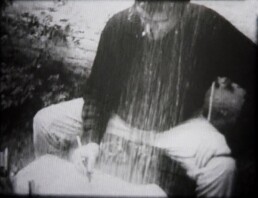
Belgian art history provides a particularly fertile context for this inquiry. Its affinities with humor, absurdity, everyday objects, and language as an evolving organism complicate the distinctions between conceptual and retinal art. Magritte’s La Clef des songes (The Key of Dreams, 1930) disrupts the relationship between words and objects through deliberately incongruous captions. In Broodthaers’s film La Pluie (1969), rain dissolves the text he writes during a performance, connecting the fragility of language to affect and institutional critique. Wet Conceptualism in Cognitive Capitalism Part II examines how contemporary technology, informational capitalism, and new labor accelerate existing contradictions and ruptures. It proposes Wet Conceptualism as a framework for addressing the extractive, often invisible relations of digitality while opening conceptual art toward cognitive, social justice, and planetary concerns.
The symposium will be accompanied by the exhibition Wet Conceptualism at Levey Kwok in Brussels, opening Saturday, October 31. Participating artists include Haseeb Ahmed, Lyndon Barrois Jr., Alighiero Boetti, Marcel Broodthaers, Jimmie Durham, TR Ericsson, Claire Fontaine, Andrea Fraser, Jef Geys, Mauro Giaconi, Liam Gillick, Mark Manders, David Maroto, My Barbarian, Warren Neidich, Laure Prouvost, Rob Pruitt, Martha Rosler, Walter Swennen, Ria Verhaeghe, and Oriol Vilanova.
Warren Neidich, founder and director
Saas-Fee Summer Institute of Art